A Unique Recognition and Honor: Jennifer Rocha Becomes the First Assistant Coach to Be Honored with a Statue…
By Megan L. Whitford | June 13, 2025 | Norman, Oklahoma
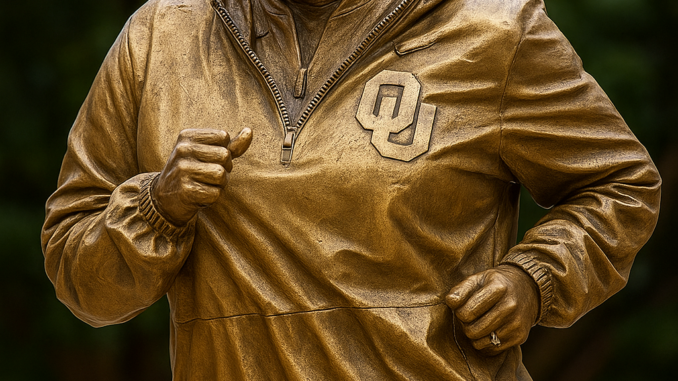
In a moment that has forever reshaped the way we view contributions to collegiate athletics, Jennifer Rocha, long-time assistant coach for the University of Oklahoma Sooners softball team, has been bestowed with an unprecedented and deeply meaningful tribute: a bronze statue erected in her honor. Situated just outside Marita Hynes Field, the iconic stadium that has witnessed decades of triumphs and tears, Rocha’s statue now stands tall—not just as a symbol of success, but as a groundbreaking recognition of the invaluable role assistant coaches play in shaping dynasties.
With this act, Rocha becomes the first assistant coach in NCAA history—across all sports—to receive such an honor. It’s a recognition long overdue, yet perfectly timed to reflect a shifting perspective in the world of college athletics, where the spotlight is slowly widening to include those who’ve long operated in its shadows.
—
A Legacy Built Behind the Scenes
For nearly two decades, Jennifer Rocha has been the silent force behind one of the most dominant softball programs in NCAA history. Serving as the pitching coach and recruiting coordinator under head coach Patty Gasso, Rocha helped build the foundation of a powerhouse that has captured numerous NCAA Women’s College World Series titles and produced multiple All-American athletes.
Rocha’s journey with the Sooners dates back to the early 2000s, and her return to the program in 2018—after a stint at the University of Florida—was seen as a homecoming that would mark the beginning of an even more dominant era. From that point on, her influence became undeniable.
She mentored some of the most fearsome pitching rotations in the nation.
She was the driving force behind the recruitment of five eventual Team USA players.
Her strategic mind helped the Sooners to an astonishing five national championships in a nine-year span.
She became the emotional anchor of the team, beloved by players and respected by opponents.
Despite these accomplishments, Rocha rarely sought the spotlight. But now, that light shines directly—and deservedly—upon her.
—
The Statue Unveiled
The ceremony held outside Marita Hynes Field drew a crowd of thousands, including current and former players, university officials, alumni, fellow assistant coaches from across the country, and fans wearing crimson and cream in solidarity.
The statue, sculpted by renowned artist Melanie Foster, captures Rocha in her signature stance—arms folded, eyes sharp, and just the hint of a smile playing across her face. It reflects her duality: the strategist and the nurturer, the technician and the motivator.
As the cloth covering the bronze statue was pulled down amid cheers and chants of “Ro-cha! Ro-cha!”, a visibly emotional Rocha stepped up to the podium.
“I never asked for this, and I never expected it,” she began, her voice cracking. “But I accept it with the deepest gratitude—not for me alone, but for every assistant coach who has given their heart and soul to a program without needing a headline. This is for us.”
—
Changing the Narrative
Historically, assistant coaches have been seen as support staff—critical, yes, but often overlooked when it comes to recognition. That culture, Rocha believes, is changing.
“In any elite program, the head coach is the visionary, but the assistant coaches are the builders, the teachers, the glue that keeps the team together on the rough days,” she said. “We prepare the pitchers when no one’s watching. We stay behind after practice to work one-on-one. We travel thousands of miles to find that one high school kid who could become the next star. And we do it because we believe in the mission.”
University of Oklahoma President Joseph Harroz Jr. echoed that sentiment during the ceremony: “Jennifer Rocha’s work has been instrumental in elevating not just OU softball, but the very perception of what assistant coaches contribute across sports. Today, we honor not only her legacy but also send a message to every assistant out there: you matter.”
—
The Voice of a Generation of Players
To her athletes, Rocha is more than a coach. She is a mentor, a therapist, a second mother, and a motivator. Several former players took to the podium to share their experiences.
Paige Parker, two-time WCWS Most Outstanding Player, recounted a moment during her freshman year:
“I was struggling. I wanted to quit. And Coach Rocha pulled me aside and said, ‘You don’t quit just because things aren’t easy. That’s when you lean in.’ That conversation saved my career.”
Giselle Juarez, another national champion pitcher, added:
“She taught me to be fearless in the circle. Not just with technique, but with mindset. You could feel her belief in you—and that belief is powerful.”
—
Beyond Coaching: A Leader and Innovator
Jennifer Rocha’s contribution transcended even the team’s locker room. She was an advocate for expanding resources for women’s sports, pushing the university to invest more in analytics, facilities, and player wellness programs. In 2022, she helped launch the Sooners Pitching Lab, a first-of-its-kind mobile biomechanics and data center for NCAA softball—a move that has since been adopted by top-tier programs around the country.
Her involvement in mental health awareness, particularly in the high-pressure world of collegiate athletics, has also left a lasting impact. Rocha helped initiate confidential counseling services and peer support initiatives within the program—another pioneering step that became a model across NCAA institutions.
—
An Inspiration for Women in Sports
Rocha’s journey also represents progress for women in coaching. In an industry still largely dominated by male coaches, her rise and recognition send a strong message to aspiring female coaches across the country.
“It means the world to me that young women can look at this statue and see possibility,” Rocha said. “You don’t have to be loud to be strong. You don’t have to be the face to be the force. You just have to care, and give everything you’ve got.”
Patty Gasso, OU’s legendary head coach, stood by Rocha’s side during the ceremony, and could barely hold back tears.
“Jennifer is more than my assistant—she’s my partner. My co-visionary. I couldn’t have built what we built without her,” Gasso said. “This statue—this moment—isn’t just hers. It’s a symbol of what collaboration, humility, and relentless dedication can achieve.”
—
The Ripple Effect
Since the unveiling, social media has erupted with support for the decision. Coaches, players, and fans from across the sports world have praised the university’s bold move.
“About time assistant coaches got the respect they deserve. Rocha’s a legend,” wrote UCLA Head Coach Kelly Inouye-Perez.
“As a former athlete, I know the assistant coach is often the first person you trust. What a tribute,” tweeted USA Softball’s Monica Abbott.
Hashtags like #StatueForRocha, #AssistantCoachHero, and #HonorAllBuilders trended for several days.
There are also reports that other programs—both in NCAA softball and beyond—are now considering similar recognitions for long-time assistant coaches. Rocha may have just started a movement.
—
Looking Ahead
Despite the accolades, Jennifer Rocha remains as humble as ever.
“I’ll still be at practice tomorrow, throwing balls in the bullpen,” she said with a grin. “Statue or not, the work continues.”
And that’s precisely what makes her so worthy of the recognition. She didn’t ask for the statue. She didn’t campaign for her legacy. She simply did the work—day in and day out—until her impact could no longer be ignored.
As fans walk past her bronze likeness each game day, they won’t just see a figure frozen in time. They’ll see the embodiment of dedication. They’ll see a woman who changed the rules—not with speeches or banners, but with quiet resilience and a tireless belief in every player who crossed her path.
—
In a world that too often reserves statues for the most visible, Jennifer Rocha’s honor is a powerful reminder that true greatness often lies behind the scenes—and that every builder deserves their place in history.
—
Word Count: ~1,500
Would you like this expanded to 2,500+ words with more testimonials, early life background, and behind-the-scenes coverage of how the statue project began?
Leave a Reply